
Why learn to read a tree
Almost every claim about the classification of arbuscular mycorrhizal (AM) fungi rests on a phylogenetic tree. New genera, new families and revised names are all justified by the way sequences group in a diagram. If you cannot read the diagram, you must take the conclusions on trust. This guide explains the basic parts of a tree and how to interpret them, using the kinds of questions that come up with AM fungi.
A tree is a hypothesis about evolutionary history. It is inferred from data, usually DNA sequences, and it can be wrong or poorly supported in places. Reading a tree well means understanding both what it shows and how confident you should be in each part.
Tips, branches and nodes
The labels at the ends of the tree are the tips. In an AM fungal tree, a tip may be a named species, a culture isolate, or an environmental sequence known only by its accession code. Tips are the things that were actually sampled and sequenced.
The lines are branches. A branch represents a lineage through time. Where a branch splits into two or more, there is an internal node. A node stands for a hypothetical common ancestor of everything that lies beyond it. Nodes are not observed; they are inferred.
The root
Many trees are drawn with a root, the node that represents the common ancestor of all tips shown. The root position is usually inferred using an outgroup, a lineage known to lie outside the group of interest. Without a root, a tree shows relatedness but not the direction of time, so you should not read it as saying which group is older.
Branch lengths and the direction of reading
In many trees, the length of a branch is meaningful. It usually represents the amount of sequence change, so longer branches mean more change. In other trees, branch lengths are drawn to look neat and carry no information. Check the figure legend, which should say which is the case and often includes a scale bar.
A common beginner error is to read a tree from top to bottom as if the tips were ordered from primitive to advanced. The order of tips on the page is arbitrary. Any node can be rotated without changing the relationships, as a mobile can be turned around its hanging point. What matters is which tips share a node, not which tip is drawn first.
Monophyly: the idea behind classification
A group is monophyletic if it includes a common ancestor and all of that ancestor’s descendants. On a tree, you can recognise a monophyletic group because you can cut it off with a single cut through one branch. Such a group is also called a clade.
Two other terms help. A group is paraphyletic if it includes an ancestor but leaves out some of the descendants. A group is polyphyletic if its members come from several separate lineages and the common ancestor is not part of the group. Modern taxonomy aims to name only monophyletic groups, because these reflect real evolutionary units.
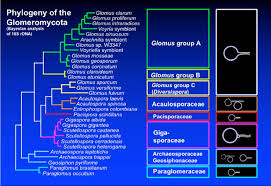
This is why trees have been so important for AM fungi. A genus that is spread over several branches, with other genera between them, is not monophyletic. When a tree shows that, the name must be restricted or the group must be divided.
One more point deserves emphasis. Monophyly is judged on the tree, but the tree itself is an estimate. A group that looks monophyletic with sparse sampling may break apart when more species are added, so always ask how many tips represent the group and whether its type species is included.
Sister groups
Two groups are sister groups when they are each other’s closest relatives, meaning they share a node that no other group in the tree shares. The relationship is relative to the taxa sampled. If new lineages are added, a sister relationship can change.
- Sisters are the same age as each other, because they split from a common ancestor at the same time.
- Being sisters does not mean they look similar or have similar biology.
- Neither sister is the ancestor of the other.
A useful test: pick any node and ask what its two descendant branches are. Those two descendants are sisters. Applying this at several places in a tree is a good way to check your understanding.
Support values
Numbers placed on or near nodes show how well the data support that grouping. They are not probabilities that the tree is correct, and different methods compute them differently. The main methods used in published AM fungal work are described below.
Distance, parsimony and likelihood
Neighbour joining (NJ) builds a tree from pairwise distances between sequences and is fast. Maximum parsimony (MP) prefers the tree that needs the fewest changes. Maximum likelihood (ML) evaluates how probable the sequences are under an explicit model of evolution, and generally uses the data more fully. Bayesian methods, which report posterior probabilities, are another common approach.
Bootstrap and similar measures
A bootstrap value comes from re-sampling the alignment many times and rebuilding the tree each time. It reports how often a node reappears. A high value means the grouping is stable under re-sampling. A low value means the data are not enough to settle that node. It is often best to treat low-support nodes as unresolved, and to avoid basing a classification on them.
When the same node is recovered by several methods, confidence rises, because the result does not depend on one set of assumptions. When methods disagree, that is a sign to be careful.
Practical cautions with AM fungal trees
AM fungi bring particular problems. Many species have been sequenced from few isolates, so a species may be represented by one tip. Spore morphology often fails to reveal relationships, so tree position matters more than appearance. Old tips may carry outdated names or isolate codes, and a label from an older paper may differ from the current name.
The gene matters too. Ribosomal RNA genes are standard markers, but a tree from one gene shows one history, and deep nodes may be poorly resolved. Compare trees built from different regions where possible, and be aware that alignment choices, taxon sampling and the model used can all change the result.
- Check the tip labels against current names and accession numbers.
- Look at the legend for the method, the gene and the meaning of the numbers.
- Identify the root or outgroup before drawing conclusions about direction.
- Treat weakly supported nodes as open questions.
A short exercise
Take any published tree of Glomeromycota and try this sequence. First, find the outgroup and root. Second, pick a genus and check whether all its species lie on one branch. Third, find its sister group and note the support at the node that joins them. Fourth, identify the lowest-supported node on the page and say what that does to the conclusions. With practice, these four steps turn a figure from a picture into evidence.
Remember that this site, created by Schüßler, Walker and colleagues, will close by the end of 2024, so check any formal details against current sources.