
A species list with new families and genera
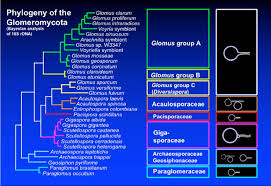
In 2010, Schüßler and Walker published “The Glomeromycota. A species list with new families and new genera”. The work did two jobs at once. It provided an annotated list of the species then recognised in the phylum, and it set out a revised classification based on a phylogenetic tree. This post describes the thinking behind the 2010 classification and the kinds of changes it made.
The central idea was to turn the pattern first seen in earlier trees into a formal scheme. Large, familiar genera such as Glomus were known to be mixtures of unrelated lineages, and a classification that kept those names unchanged could no longer be defended.
The evidence: a near-full-length SSU tree
The 2010 revision relied on a tree of the small subunit (SSU) ribosomal RNA gene, using sequences of close to the full length of the gene. Longer sequences contain more variable and informative positions than short fragments, which generally gives better resolution of relationships and more reliable placement of the groups in the tree.
Ribosomal genes are a practical choice for several reasons. They are present in all fungi, they can be aligned across large evolutionary distances, and a large reference collection of sequences already existed. Basing the classification on a well-sampled gene also meant that other researchers could place their own sequences on the same framework.
A deliberately conservative approach
The authors described their approach as a relatively conservative attempt. In a field where each new genus or family changes names that people have used for years, there is a real cost to proposing many new taxa. The aim was therefore to keep the number of new taxa as small as the evidence allowed, while still producing groups that are monophyletic.
This is a useful lesson in how classifications are built. A phylogeny does not dictate a unique set of names. It tells you which groupings are natural, and the taxonomist decides how finely to divide them. A conservative scheme chooses the coarsest division that remains consistent with the tree.
Correcting identifications and synonymies
Constructing the list was not simply a matter of attaching names to branches. Some earlier identifications were wrong, and some species had been placed as synonyms of each other when the evidence did not justify it. These misidentifications and mis-synonymisations had to be corrected before the tree could be interpreted sensibly.
Two examples show how names changed as a result:
- The isolate known as Glomus versiforme BEG47 is Diversispora epigaea.
- The widely used isolate known as Glomus intraradices DAOM197198 is Rhizophagus irregularis.
The second example matters especially because that isolate has been used in many laboratory experiments. A paper that reports work on “Glomus intraradices” may be referring to the lineage now called Rhizophagus, and readers need to know this to compare studies.
The split of the Glomerales
The 2010 paper concluded that a long-proposed split of the Glomerales was necessary. The tree showed that the order, as then understood, contained groups that were not each other’s closest relatives. Dividing it into separate lineages gave names that matched the tree.
The new genera proposed or established in this context included Funneliformis, Claroideoglomus, Rhizophagus and Redeckera. Each corresponds to a branch that the tree placed apart from the main Glomus lineage, even though many of its species had long been treated as Glomus. Having separate names for these branches means that a genus name now says something real about relatedness.
Anchoring Glomus with its type species
A key step concerned the name Glomus itself. Under the Botanical Code, a genus name belongs to the lineage that contains its type species. If the type species cannot be placed in the tree, the name cannot be applied with confidence, and the whole revision is left uncertain.
The type species of Glomus is Glomus macrocarpum. The authors fixed the anchor by culturing this species, which made it possible to obtain sequence data from a living, verified isolate and to place the type in the tree. With the type located, the name Glomus could be restricted to the group that contains it, and the other groups could be named separately.
Why culturing was needed
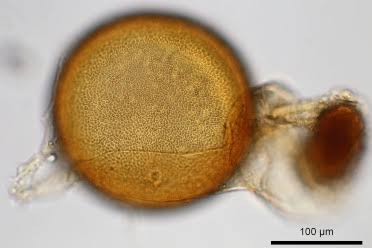
Many AM fungi are known mainly from spores in field samples, and linking a particular spore to a sequence can be difficult. A culture maintained on a host plant provides material that can be examined morphologically and sequenced at the same time, reducing the risk of attaching the wrong sequence to a name.
Why a species list belongs with a tree
Combining a species list with a classification has a practical logic. A tree is only useful if its tips can be connected to named species, and a species list is only trustworthy if the names have been checked against the evidence. By doing both together, the authors could test each name against the tree and flag those that did not fit.
Some species could not be placed because no sequence data were available. Others had been described from material that could not be re-examined. A list of this kind is therefore a working document: it records the best current judgment, and it is expected to change as new isolates are sequenced and old types are reassessed.
Limits of the 2010 scheme
No single-gene classification is final. A tree from one gene region reflects one history, and relationships among the deepest branches are often weakly resolved. A conservative scheme handles this by avoiding strong claims where support is limited, but it cannot remove the uncertainty.
The scheme also depended on the sampling available. Lineages that were not yet sequenced could not be included, and later work has repeatedly refined the picture. That is a normal part of the process, not a failure of the 2010 effort. A classification is a statement about current knowledge, and it can be tested and improved by additional data from other genes and more taxa.
How to use the 2010 classification
For a student, the 2010 paper is a bridge between the older, morphology-based system and the one in use today. When reading older work, translate genus names using the examples above, and keep track of isolate codes. When reading newer work, remember that the genera named in 2010 are defined by position in the tree, not just by spore features.
The classification followed the Botanical Code and the nomenclatural record in Index Fungorum, and it did not adopt the subphylum name Glomeromycotina. This site follows the same approach. The Code is binding for names up to the rank of family, so those names carry the most formal weight.
It should also be kept in mind that the site is run by the authors of the 2010 work and will close by the end of 2024, and that some pages may be outdated from the formal point of view.
Summary
- The 2010 revision used a near-full-length SSU rRNA gene tree.
- It aimed to be conservative, proposing as few new taxa as the data allowed.
- Misidentifications and mis-synonymisations were corrected along the way.
- The Glomerales had to be split, giving new genera such as Funneliformis, Claroideoglomus, Rhizophagus and Redeckera.
- Glomus was anchored by culturing its type species, Glomus macrocarpum.