
Why this tree mattered
In 2001, Schwarzott, Walker and Schüßler published a phylogenetic analysis in Molecular Phylogenetics and Evolution (volume 21, pages 190-197) that changed how specialists thought about the largest genus of arbuscular mycorrhizal (AM) fungi. The genus was Glomus, and at the time it sat in the order Glomales. Its headline result was simple to state and hard to ignore: Glomus is not monophyletic.
That sentence sounds technical, but it has practical weight. Taxonomy is supposed to group organisms that share a common ancestor. If a genus name covers species that arose from several separate lineages, the name no longer tells you anything reliable about relatedness. For a genus containing so many species, that was a serious problem for anyone naming, comparing or studying these fungi.
The problem with spore morphology
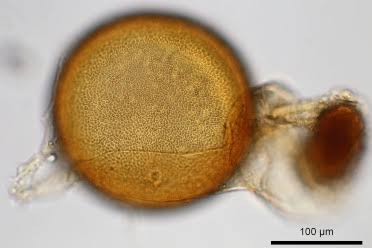
AM fungi are obligate symbionts of plant roots, and they reproduce asexually by large multinucleate spores formed in soil or in roots. Early classification relied heavily on what could be seen under the microscope: spore size, colour, the number and structure of spore wall layers, and how the spore is attached to the hypha that bears it.
Many species formed simple spores on a single hypha, with few features to distinguish them. Such spores were placed in Glomus by default. This kind of grouping works as a practical filing system, but it can hide deep evolutionary differences. Simple, similar-looking spores can arise independently, or can be what is left when more elaborate features are lost. Morphology alone could not decide between these possibilities.
What molecular data added
Molecular phylogenetics offers an independent line of evidence. The approach uses a gene present in all the organisms of interest, compares its sequences, and infers a tree from the differences. For fungi, ribosomal RNA genes are a standard choice. These genes occur in every cell, contain both conserved stretches that can be aligned across distant relatives and variable stretches that carry signal for closer relationships, and can be amplified with widely used primers.
The 2001 study used ribosomal gene sequences from a broad sample of AM fungi, spanning the groups then recognised. The result was a tree in which species traditionally named Glomus did not form a single branch. Instead, they appeared in several places, mixed with lineages that had their own distinctive genera and families.
Glomus Groups A, B and C
The tree showed that the species then called Glomus fell into distinct clusters. These were later referred to informally as Glomus Groups, abbreviated GlGrA, GlGrB and GlGrC. The abbreviations are useful shorthand: they allow researchers to talk about a lineage clearly without immediately committing to a formal name.
Why the groups were treated separately
Each group was a coherent branch, but the groups were not each other’s closest relatives. Some were more closely related to fungi in other families than to the other Glomus groups. This is exactly the pattern that makes a genus non-monophyletic. A monophyletic group must contain an ancestor and all of its descendants. Here, a single genus name was spread over several branches, and other genera sat between them.
Groups and families
The tree already indicated a structure that fitted this idea: the different Glomus groups belonged in different families. This was not yet a formal reclassification. It was a pattern in the data that pointed toward one. The formal treatment of these lineages came later, in 2010, when the groups were assigned to separate families and genera.
Reading old names in old trees
Anyone returning to the 2001 literature meets labels that no longer match current names. Isolates were often identified by a culture collection code, and some of those codes appear as tip labels in older trees. One example is BEG47, an isolate originally identified as a Glomus species. Under current classification it is Diversispora epigaea. The name in a figure caption therefore depends on when the figure was drawn.
This has a practical lesson for students. When you read an older tree, check the tip labels against current names, and keep the isolate or accession code, which stays stable while the species name changes. Misidentification and later synonymisation were common, so a label is a hypothesis, not a fact.
- Tip labels may reflect the identification made at the time of sampling.
- Culture collection codes persist even when the species name is revised.
- A family name in an old tree may no longer exist or may have a changed circumscription.
From signal to formal classification
A single gene tree, however clear, is not the end of the story. The 2001 work showed the problem and suggested its shape. Turning that into a stable classification required more sequences, more careful species identification, and attention to the rules of nomenclature. The groups first seen as clusters had to be tied to type species, because under the Botanical Code a genus name is anchored to the type of its genus, and the name stays with the lineage that contains that type.
That step matters. The name Glomus can only be kept for the group that includes its type species. The other groups need other names, and either existing names must be revived or new ones proposed. This explains why the path from the 2001 tree to a full revision was long: the biology was clear before the nomenclature was settled.
Strengths and limits of the 2001 analysis
The strength of the paper was that it tested an assumption nobody had been able to test properly. It showed that a large and familiar genus was an artificial assemblage, using data that could be repeated and checked by other laboratories.
There were limits, as there are in any early study. A single marker region captures one history, and some branches deep in a tree are hard to resolve with one gene. Taxon sampling was limited by what could be sequenced at the time, and many species had not been sequenced at all. Readers should therefore treat the 2001 tree as a first, well-founded map of the main groups, not as a final statement about every species.
It is also worth remembering that this website is maintained by the authors of these studies and will close by the end of 2024. Some information here may be outdated from a formal point of view, so current names should be confirmed against an up-to-date nomenclatural source.
How to use this result today
If you work with environmental sequences or older isolates, the practical advice is to avoid treating the name Glomus in older papers as a reliable indicator of lineage. Ask which group the sequence belongs to, and place it on a current tree. The group labels GlGrA, GlGrB and GlGrC remain a convenient bridge between old and new literature.
Take-home points
- The 2001 study showed that Glomus, the largest AM fungal genus, is non-monophyletic.
- The tree revealed several Glomus Groups, GlGrA, GlGrB and GlGrC, located in different families.
- Simple spore morphology can group unrelated lineages together, which is why molecular data were needed.
- Old tip labels such as BEG47 may correspond to different names today; BEG47 is now Diversispora epigaea.
- The structure seen in 2001 was formalised in 2010, once names and types could be properly assigned.