
A reorganisation of the Diversisporales
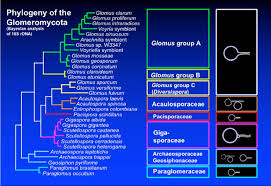
In 2004, the classification of one part of the arbuscular mycorrhizal (AM) fungi was substantially rearranged. The order Diversisporales was reclassified, and two families took on a new role: Pacisporaceae and Diversisporaceae. These families contain species that had formerly been placed in the genus Glomus. The change followed from the earlier finding that Glomus was not a natural, monophyletic group, and it showed what correcting that problem looks like in practice.
The same year also produced a small but instructive episode in nomenclature, in which two research groups independently described the same new genus under two different names. Understanding that episode is a good way to learn how the priority rules of the Botanical Code work.
Why species left Glomus
Several species that looked like Glomus by their spore morphology turned out, in molecular trees, to belong with lineages unrelated to the main Glomus group. When a species is found on a branch far from the type species of its genus, the name has to change. The species either moves to an existing genus that fits its branch, or a new genus is needed.
For some species formerly called Glomus, the right place was within the Diversisporales, an order that also includes families with more elaborate spore structures. This is a good example of how simple spores can be a derived or reduced condition, not a sign of close kinship.
Support for the sister-group relationship
The 2004 analysis examined how well the data supported key relationships. In particular, it looked at the relationship between Pacisporaceae, also known as Gerdemanniaceae, and Gigasporaceae. The data were analysed with several different approaches: neighbour joining (NJ), maximum parsimony (MP), maximum likelihood (ML) and a quartet-puzzling version of likelihood (ML-QP). Support values from these methods were reported for the sister-group relationship of Pacisporaceae and Gigasporaceae.
Why report several methods
Each method makes different assumptions. NJ builds a tree from pairwise distances and is fast. MP prefers the tree needing the fewest character changes. ML evaluates how probable the data are under an explicit model of sequence evolution. When a relationship is recovered by all of them, it is less likely to be an artefact of one method. Reporting support values from several analyses lets readers see how robust a grouping is, not merely whether it appeared once.
What sister groups mean here
Two groups are sisters when they share a more recent common ancestor with each other than with any other group in the tree. Saying that Pacisporaceae and Gigasporaceae are sister groups therefore means that, among the lineages sampled, they are each other’s closest relatives. It does not mean they look alike, and it does not mean one is derived from the other.
Two names for one genus
The naming story is the most memorable part of the 2004 work. Walker, Blaszkowski, Schwarzott and Schüßler described the genus Gerdemannia and the family Gerdemanniaceae in Mycological Research (volume 108, issue 6, pages 707-718). At about the same time, another group described the same genus as Pacispora, and placed it in the family Glomeraceae.
The authors of Pacispora knew about the plan to publish Gerdemannia. The authors of Gerdemannia, however, did not know about the Pacispora plans. By the time the overlap was clear, both papers were already in press and neither could be withdrawn.
How the priority rule settled it
The Botanical Code resolves such conflicts by priority of publication. When two names are published for the same taxon, the earlier valid name is used, and the later one becomes a synonym. In this case Pacispora was published slightly earlier than Gerdemannia. Consequently, Gerdemannia is a later synonym, and Pacispora is the correct genus name.
The nomenclatural position was clarified in a short follow-up by Walker and Schüßler in Mycological Research (volume 108, pages 981-982). The correct name Pacispora applies to species formerly placed in Glomus, including the species once known as Glomus scintillans, G. dominikii and G. chimonobambusae.
There is a second consequence. The original placement of Pacispora in Glomeraceae was not supported by the molecular data, which pointed to a position among the Diversisporales. The family name that follows from the correct genus is Pacisporaceae, which is why the older name Gerdemanniaceae appears in the literature as an equivalent.
Relationship to Gigasporaceae
Gigasporaceae is a related family that forms the sister group in the analyses described above. Members of Gigasporaceae are known for distinctive spores that develop on a swollen, bulb-like structure, and they form a recognisable family in the order. The finding that the former Glomus species of Pacisporaceae are closely related to this family is a clear example of why simple spore appearance cannot be used to infer relatedness.
It also illustrates a general point in AM fungal taxonomy. Families can contain species with very different spore forms, while spore forms that look the same can belong to families far apart on the tree.
Why nomenclature rules matter
It may seem odd that a taxonomic question can turn on which of two papers reached print first. The reason is stability. If every author were free to choose among competing names, the same fungus would be known under different labels in different laboratories, and databases, herbarium records and sequence entries would drift apart. Strict priority is blunt, but it is predictable.
The Botanical Code is also what makes the family level meaningful here. Its rules are binding up to the rank of family, so the correct family name follows from the correct genus name in a defined way.
Reading trees from this period
If you open a paper from around 2004 you will often find the same fungi under several names. A species may appear as Glomus, as Gerdemannia or as Pacispora, depending on the source and its date. A few habits help.
- Note the publication date and compare it with the nomenclatural changes described above.
- Follow the species epithet and the isolate code, not the genus name alone.
- Look at where the species sits in the tree: a position near Gigasporaceae suggests Pacisporaceae, whatever the label says.
- Check that support values are given for the node you care about, and which method produced them.
What to remember
The 2004 reorganisation matters for two reasons. First, it gave a concrete demonstration that species placed in Glomus could belong to different families within the Diversisporales, strengthening the argument for splitting the genus. Second, the Gerdemannia and Pacispora episode is a textbook case of how independent work can collide, and how priority, not preference, decides which name survives.
- Pacisporaceae and Diversisporaceae were introduced for species formerly assigned to Glomus.
- Support for the sister relationship of Pacisporaceae and Gigasporaceae was assessed with NJ, MP, ML and ML-QP.
- Pacispora was published slightly earlier than Gerdemannia, so Pacispora is the valid name.
- When reading older literature, expect to meet both names, and check which one the authors used.
As with other pages on this site, the information reflects the status at the time of writing, and some details may be outdated from a formal point of view. The site is due to close by the end of 2024.