
Aiming for a consensus
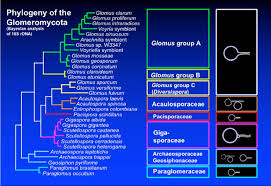
By 2013, several classifications of the Glomeromycota were in circulation, and they did not always agree. Researchers working on the same fungi might use different genus names, different family limits and different views of which groups were well supported. In that year, Redecker, Schüßler, Stockinger, Stürmer, Morton and Walker published a joint paper in Mycorrhiza (volume 23, pages 515-531) offering an evidence-based consensus for the classification of the phylum.
The key word is consensus. The authors came from different laboratories and had, in some cases, published competing proposals. The paper represents an effort to set out a shared framework that the community could use, based on what the evidence supported at the time.
What evidence-based means
An evidence-based classification does not mean that every name is certain. It means that each taxon is judged against the data available, and that the paper is open about where the data are strong and where they are weak. In practice, this involves asking several questions of each genus and family.
- Is the group monophyletic in the trees that were published?
- Was the group described using adequate material, such as well-documented specimens and sequences?
- Is its position in the tree supported, or is it uncertain?
- Does the name conform to the nomenclatural rules?
Answering these questions honestly produces a list that separates well-founded groups from provisional ones. That separation is the main practical contribution of the paper.
The use of asterisks
One feature of the consensus classification is the use of asterisks. Genera marked with an asterisk are regarded as questionable. The reason can be the data used for the original description, the phylogenetic position, or both. For example, a genus might have been described from limited material, or its position in the tree might rest on a sequence of doubtful origin.
How to read an asterisk
An asterisk is a flag, not a verdict. It does not say the genus is wrong. It says that users should be careful when relying on it, and that more data would help. For a student, this is a useful habit of thought: a classification can carry its own estimate of reliability.
Why flagging is helpful
Without such flags, every name in a list looks equally solid. Users then build ecological or evolutionary analyses on taxa that may later be revised. By marking uncertain genera, the consensus allows researchers to weigh the risk of using each name, and it identifies where new work is most needed.
The question of splitting Gigasporaceae
The paper also reflects the discussion over how finely to divide established families. An alternative scheme had proposed dividing Gigasporaceae into four families and five genera. Morton and Msiska, in 2010, did not support that split. The 2013 consensus likewise follows a more cautious view of the family.
This disagreement shows an important principle. Two classifications can both be consistent with the same tree and still differ in how many ranks they use. The choice depends on how strong the evidence for each division is, and on how useful the finer divisions are in practice. Because a tree can be cut at different places, the decision is partly a matter of judgment, and a consensus is valuable because it records a judgment shared by several experts.
Relationship to earlier revisions
The consensus builds on the earlier steps in the story of Glomeromycota classification. It follows the recognition that Glomus was not monophyletic, the reorganisation of the Diversisporales, and the revision that introduced new families and genera on the basis of a ribosomal gene tree. Each step tightened the match between the names and the tree, and the 2013 paper takes stock of where this left the group.
In this sense the consensus is as much a summary as a new proposal. It gathers the accepted results, identifies the open questions, and gives the community a reference point against which future changes can be measured.
Nomenclature and where the authors stand
Names remain a separate issue from phylogeny. The classification used here and on this site follows the Botanical Code, which is binding up to the rank of family, and uses Index Fungorum as the nomenclatural reference. The group does not adopt the name Glomeromycotina for the lineage, and keeps to the phylum rank. This is a choice about nomenclature and ranks, not a disagreement about the evolutionary relationships among the fungi.
For readers, the consequence is straightforward. Literature may use different higher-rank names for the same lineage, so it is wise to check which scheme a paper follows before comparing results.
Why a consensus is hard to reach
Agreement on a classification is harder than agreement on a tree. Researchers can accept the same branching pattern and still disagree on three points: which branches deserve a formal name, which rank each name should have, and how much weight to give a weakly supported node. Each of these is a judgment, and each can be defended.
The AM fungi add difficulties of their own. Many species are known from few collections. Spores can be hard to link to sequences, and some lineages are known only from environmental DNA. A consensus has to work around these gaps, which is why the paper marks uncertainty instead of hiding it.
What the consensus does not do
The paper is not a final classification, and it is not a complete census of every species. It does not settle every disagreement, and it does not remove the need to check names against the original descriptions and the type material. It also cannot anticipate sequences that have not yet been generated.
It is best understood as a stable, documented starting point. A reader who disagrees with a specific placement has a clear way to proceed: collect better data, test the group in a tree, and report the result so that the next revision can take it into account.
Key points
- The 2013 paper in Mycorrhiza sets out an evidence-based consensus for classifying the Glomeromycota.
- Genera marked with asterisks are questionable, because of the data used for description, the phylogenetic position, or both.
- Morton and Msiska (2010) did not support splitting Gigasporaceae into four families and five genera.
- The group follows the Botanical Code, uses Index Fungorum, and does not adopt Glomeromycotina.
- Treat the consensus as a framework that will continue to be refined.
Using the consensus in practice
When writing a paper or building a reference database, the consensus provides a sensible default. You can use its genera and families as a starting framework, treat asterisked genera with caution, and cite the evidence for any departure from it. If you work with sequences from the environment, you can place them on a tree built with reference taxa and report their position, rather than forcing them into a name that the data cannot support.
Finally, keep in mind that this website was created by Schüßler, Walker and colleagues, will close by the end of 2024, and may contain information that is outdated from the formal point of view. The most recent literature and nomenclatural databases should always be checked before names are used in a publication.