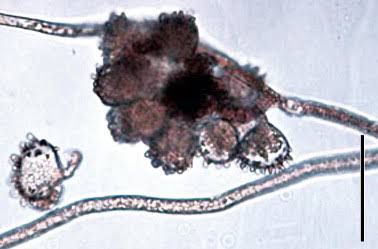
A genus that grew too large
For a long time, Glomus was the default home for arbuscular mycorrhizal (AM) fungi that form spores singly or in clusters, with a spore wall that appears to be attached to a simple, straight hypha. The description was short, the spores were easy to recognise as belonging to the group, and the genus grew steadily as new species were found. It became by far the largest genus in the phylum.
That size was a warning sign. A genus defined mostly by what its members lack, rather than by features they share, tends to collect species that look alike for lack of anything better to say. Simple spores formed on a hypha can arise more than once, and similar-looking spores do not guarantee close relationship. The question was whether Glomus was a natural group at all.
What the molecular data showed
The answer came when sequences of ribosomal RNA (rRNA) genes became available for many species. These genes are present in every organism, contain both slowly and quickly evolving regions, and are well suited to reconstructing relationships among fungi. When Glomus species were placed on a tree together with members of other genera, they did not form a single branch.
Schwarzott, Walker and Schüßler (2001, Molecular Phylogenetics and Evolution 21:190-197) demonstrated that Glomus, the largest genus, is not monophyletic. A monophyletic group contains an ancestor and all of its descendants. Glomus did not meet that standard: its species fell into several separate lineages, informally called Glomus Groups, including GlGrA, GlGrB and GlGrC. These groups lie in different families, which means they are separated by deep evolutionary divisions, not by minor differences between close relatives.
Why this matters beyond naming
A non-monophyletic genus gives misleading information. If a researcher reads that two fungi are both “Glomus“, the natural assumption is that they are close relatives with similar biology. For species from different Glomus Groups, that assumption is wrong. Comparisons of physiology, host response, ecology or genome content would mix lineages that diverged long ago. A classification should let a name carry reliable evolutionary meaning.
The principle behind the revision
Modern classification aims to recognise only monophyletic groups. When a genus is shown to contain unrelated lineages, there are two broad options: leave it as an informal assemblage and accept the confusion, or divide it so that each resulting genus represents one lineage. For Glomus the evidence strongly favoured division. Several of the lineages were also distinct enough to be placed in different families, so the revision had to operate at more than one rank.
The work was done in the framework of the Botanical Code, which also governs fungal names. Up to and including the rank of family, the Code is binding, so names at those levels must follow its rules on typification and priority. This is why the position of the type species of a genus is so important. The name Glomus stays with the lineage that contains its type, and everything else must go elsewhere or receive a new name.
A conservative attempt: the 2010 species list
Schüßler and Walker (2010) published “The Glomeromycota. A species list with new families and new genera”. It was intended as a relatively conservative attempt. The aim was not to create as many names as the data might allow, but to make the changes that the evidence clearly required. Splitting the Glomerales was judged necessary, and the new genera included Funneliformis, Claroideoglomus, Rhizophagus and Redeckera.
Two examples show how this affects names that appear in many papers and culture collections:
- The isolate known for many years as Glomus intraradices DAOM197198 is Rhizophagus irregularis.
- The isolate Glomus versiforme BEG47 is Diversispora epigaea.
In both cases the isolate was never a problem; the genus label was. Readers of older literature need to know these equivalences, because the same living material may appear under different names depending on the publication date.
Anchoring the name Glomus
One difficulty was that the genus name itself was not firmly attached to a living, characterised organism. A genus name is tied to its type species, and for a long time the type species of Glomus, Glomus macrocarpum, was poorly known in molecular terms. Without a sound link between the name and a sequence, it was hard to say with confidence which of the lineages should keep the name Glomus.
This was resolved only recently, by culturing and characterising Glomus macrocarpum. With the type species in hand, the anchoring of Glomus is now fixed. That step gave the revision a secure foundation: the lineages that were separated out can be understood in relation to a genus whose identity is no longer in doubt.
Consolidation and critical review
A revision of this scale needs checking. Redecker and colleagues (2013, Mycorrhiza 23:515-531) presented an evidence-based consensus classification of the group, bringing together information from many researchers. It remains a useful reference, though it also shows that some of the genera it lists are questionable and may need further work.
Not every proposed split has been accepted without debate. Morton and Msiska (2010, Mycorrhiza 20:483-496) argued against dividing the Gigasporaceae into four families and five genera. Their paper is a reminder that there is a difference between recognising lineages that the data clearly support and subdividing a group more finely than the evidence demands.
Some taxa were corrected
Some published taxa were themselves questionable and had to be corrected. Among the taxa proposed in the last decade, some are well supported and some are not. Users of the classification should therefore not assume that every name in print is equally reliable. Looking at the evidence behind a name, such as sequence data, a clearly designated type and a proper description, is part of good practice.
Following the Code, not taxa inflation
The authors of this site stay with the Botanical Code and use Index Fungorum as an expert system for names. This is a deliberate choice. They do not follow what might be called taxa inflation, where some authors create new genera and families by their own rules and ignore parts of the Code. Such practice leaves the literature with competing and sometimes invalid names that are difficult to sort out later.
A sound taxonomic revision needs three things: evidence from molecular and morphological data, strict observance of the rules of nomenclature, and restraint. The division of Glomus was necessary because the data showed that it was not a natural group.
As a note on the status of the information: the site will close by the end of 2024, and the data may be outdated from the formal point of view. Readers who need the current valid name of a species should check Index Fungorum and the most recent literature.
Practical advice for readers
- When reading older papers, translate Glomus names to current genera, especially for well-studied isolates.
- Report the isolate or culture collection number whenever you can, since it links the work to the same living material despite later name changes.
- Prefer sequence evidence for identification, alongside spore morphology.
- Treat recently proposed taxa with care, and check whether others have confirmed them.