Why naming needs rules
Every organism needs a name that everyone can use for the same thing. Without agreed rules, one fungus could carry several names in different laboratories, and one name could be applied to several fungi. For arbuscular mycorrhizal (AM) fungi, the phylum Glomeromycota, the problem is made worse by the small number of visible features and by the rapid growth of molecular data. A consistent approach to nomenclature is therefore not a formality. It is what keeps the literature readable.
The group behind this reference site relies on two kinds of support: databases that record names, and a code of rules that governs how names are created and used. This post describes both, and ends with a short note on a related fungus, Geosiphon pyriformis.
Taxonomy and nomenclature are different things
It helps to separate two ideas that are often confused. Taxonomy is the science of deciding which organisms belong together and how groups are arranged. Nomenclature is the system of giving correct names to those groups. A taxonomist may decide that two species are really one, but nomenclature determines which of the available names must then be used.
Because the two are linked yet distinct, a disagreement about a name can mean either a different view of the biology or a different reading of the rules. Knowing which of the two is at stake makes such debates much easier to follow.
Index Fungorum and Species Fungorum
The reference site lists Index Fungorum and Species Fungorum, hosted by CABI Biosciences, among its resources. They provide taxonomic information on fungi and cover all described fungal species. They are the standard places to look up whether a name has been published, who published it, and how it has been classified.
How the group uses Index Fungorum
The group uses Index Fungorum as an expert system. This phrase means that the database is treated as a reference to consult when deciding on the status of a name, rather than as the final authority in every case. The records show the history of a name, including whether it has been moved to another genus, so that a researcher can follow the chain from an old name to the current one.
A practical check
Before using a species name in a manuscript, it is good practice to search for it. Look at the author of the name, the original publication and any recorded synonyms. If your name is not the one currently in use, you need to decide whether to adopt the current name and mention the old one in parentheses. It takes only a few minutes. This small step protects readers from confusion, especially when an older name is still common in the literature.
The Botanical Code
Fungi are named under the International Code of Nomenclature for algae, fungi, and plants, often called the Botanical Code. The group sticks to this code. It sets out how a name is validly published, how types are designated, and which name has priority when several exist for the same taxon.
Priority and its limits
The principle of priority says that, in general, the earliest validly published name for a taxon is the correct one. The Code makes this binding for ranks up to and including family. Names above the rank of family, such as orders, classes and phyla, are not governed by priority. For these, authors have more freedom, and the choice is guided by common sense, usage and the ability to give a name that fits the group as it is now understood.
This difference has practical consequences. A genus name or a family name must follow the rules of priority and typification closely, while a higher-level name can be introduced or revised with less constraint. Anyone who proposes a new higher group should therefore expect more discussion and less automatic acceptance.
Types and the stability of names
At the heart of the Code is the type method. Each name of a species is tied to a type specimen, each genus name to a type species, and each family name to a type genus. If a name’s type is lost or cannot be interpreted, the Code allows a new reference to be designated. This is what makes it possible to anchor a name firmly and keep it stable even when the original material is no longer useful.
Working with names in sequence-based studies
Modern studies of AM fungi often start from DNA, and sequences in public databases carry names that were assigned by the person who submitted them. Those names may be wrong, outdated or applied to poorly defined species. The group has warned about this, together with uncharacterised variation within species and biased selection of sequences in some publications.
- Do not trust a species label on a sequence without checking where it came from.
- Compare labels with the current accepted name in Index Fungorum.
- Prefer sequences linked to a cultured isolate or a documented specimen.
- State clearly which names and sources you used, so that others can retrace your steps.
When a lineage is known only from sequences and has no formal name, say so honestly and use a clearly marked working label. Giving a formal name should wait until there is a type that can be examined and a description that meets the rules.
A related fungus: Geosiphon pyriformis
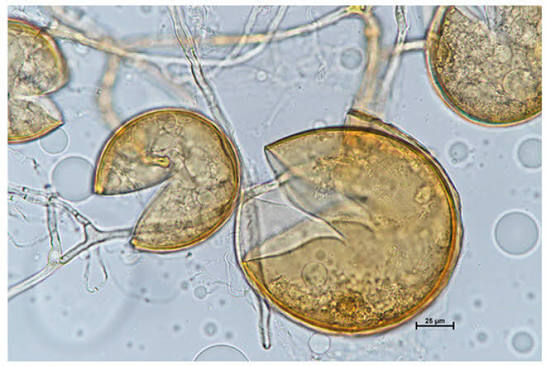
The site also contains pages on the Geosiphon symbiosis. These describe Geosiphon pyriformis, presented there as an AM fungus that forms a symbiosis with cyanobacteria. It is a good example of how the same fungal group can enter very different partnerships.
In general terms, the fungus forms small bladder-like structures that enclose cells of a cyanobacterium of the genus Nostoc. The cyanobacterium carries out photosynthesis and can fix nitrogen, and the fungus provides a protected home inside its own cells. This is unlike the usual AM association, in which the fungus lives inside plant roots and exchanges mineral nutrients for sugars and lipids from the plant.
For nomenclature, Geosiphon is a reminder that a name has to reflect relationships and not only lifestyle. A fungus that lives with cyanobacteria rather than with a plant might be expected to be distant from the root symbionts, yet the evidence places it with the AM fungi. Appearance and way of life alone would not have revealed this. Such cases show why molecular data and formal rules must work together.
Keeping up with change
Nomenclature is never finished, and a careful author treats every name as a statement that can be revised.
Names change as knowledge grows. New genera are described, species are moved, and families are rearranged. The reference site itself was created by Schüßler, Walker and colleagues and is due to close by the end of 2024, so some of its information may be outdated from the formal point of view. For this reason, treat it as a guide and confirm every name you intend to publish against a current database and the text of the Code.
A sound habit for any author is to cite the name, the authority and the source of the classification used. That small effort lets readers see exactly which version of the taxonomy stands behind a study, and it makes future corrections much easier.